7 min read · 12 May 2026 · SLS Engineering Team
Precision in Motion: A Deep Dive into Ball Screw Technology
Why ball screws — not lead screws — drive modern CNC, aerospace and robotics: efficiency, preload, return styles, and how to make them last.
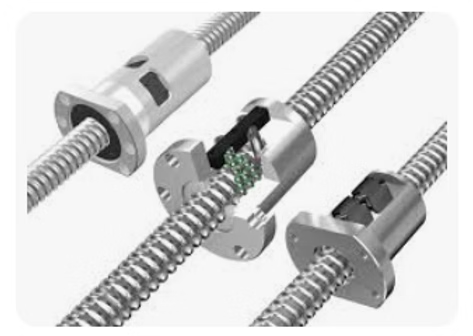
In the world of industrial automation and CNC machining, moving a heavy load is easy — but moving it with micron-level precision at high speeds is where the challenge lies. This is where the ball screw excels.
At SLS Bearings India, we don't just supply bearings; we provide the precision components that drive modern manufacturing. In this guide we explore why ball screws are the go-to choice for high-performance linear motion.
What is a ball screw?
A ball screw is a mechanical linear actuator that translates rotational motion into linear motion with minimal friction. It consists of a threaded shaft (the screw) and a nut that houses recirculating ball bearings.
The magic happens in the rolling contact. Unlike standard lead screws that use sliding friction (metal-on-metal or metal-on-plastic), ball screws use rolling balls to achieve mechanical efficiencies of 90% to 95%.
Key components of a ball screw system
- Screw shaft — the rotating heart of the system with precision-ground or rolled helical grooves.
- Ball nut — the housing that moves linearly; it contains the ball return mechanism.
- Ball bearings — hardened steel (or sometimes ceramic) balls that carry the load.
- Return system — channels that pick up the balls at the end of the nut and recirculate them back to the start.
Choosing the right nut: internal vs external returns
The way the balls move back to the start of the nut determines the speed and size of your assembly:
- Internal return (deflector type) — balls stay inside the nut's diameter. Compact, slim design — ideal for tight spaces.
- External return (tube type) — small return tubes sit outside the nut. Robust and handle larger ball diameters; great for heavy-duty industrial loads.
- End-cap type — used for high-speed applications where balls are guided through the nut's end caps for a smoother, quieter transition.
Ball screw vs lead screw
| Feature | Ball screw | Lead screw |
|---|---|---|
| Efficiency | 90 – 95% | 20 – 70% |
| Precision | Ultra-high (zero backlash via preload) | Moderate |
| Speed | Excellent for rapid movement | Slower due to heat buildup |
| Duty cycle | Continuous operation | Intermittent (needs cool down) |
| Self-locking | No (will back-drive under load) | Yes (good for vertical stops) |
Industrial applications
Because of their accuracy and load capacity, you will find ball screws in:
- CNC machine tools — driving X, Y and Z axes of milling machines and lathes.
- Aerospace — fly-by-wire actuators and wing-flap controls.
- Semiconductor manufacturing — moving silicon wafers with extreme precision.
- Robotics — providing smooth, repeatable motion in robotic arms.
Maintenance tips for maximum life
A high-quality ball screw from brands like leading brands or THK can last for years if maintained properly:
- Lubrication is king — never run a ball screw dry. Use light oil for high speeds and NLGI 1 or 2 grease for heavy loads.
- Protect from chips — use bellows or telescopic covers to keep metal chips and dust away from the screw. One piece of grit can destroy the precision grooves.
- Check alignment — a misaligned ball screw creates side-loading, which wears down the ball nut prematurely.
Conclusion
Whether you are building a high-speed packaging line or a precision medical device, the ball screw is the gold standard for efficiency. SLS Bearings India is your trusted partner for sourcing premium ball-screw assemblies from the world's leading manufacturers.
Talk to SLS Bearings India
Have a real bearing problem we should write about — or one we should solve? Reach our team.