NTN Housing Bearings
Bearings with solid grease
For food machinery and other demanding environments.
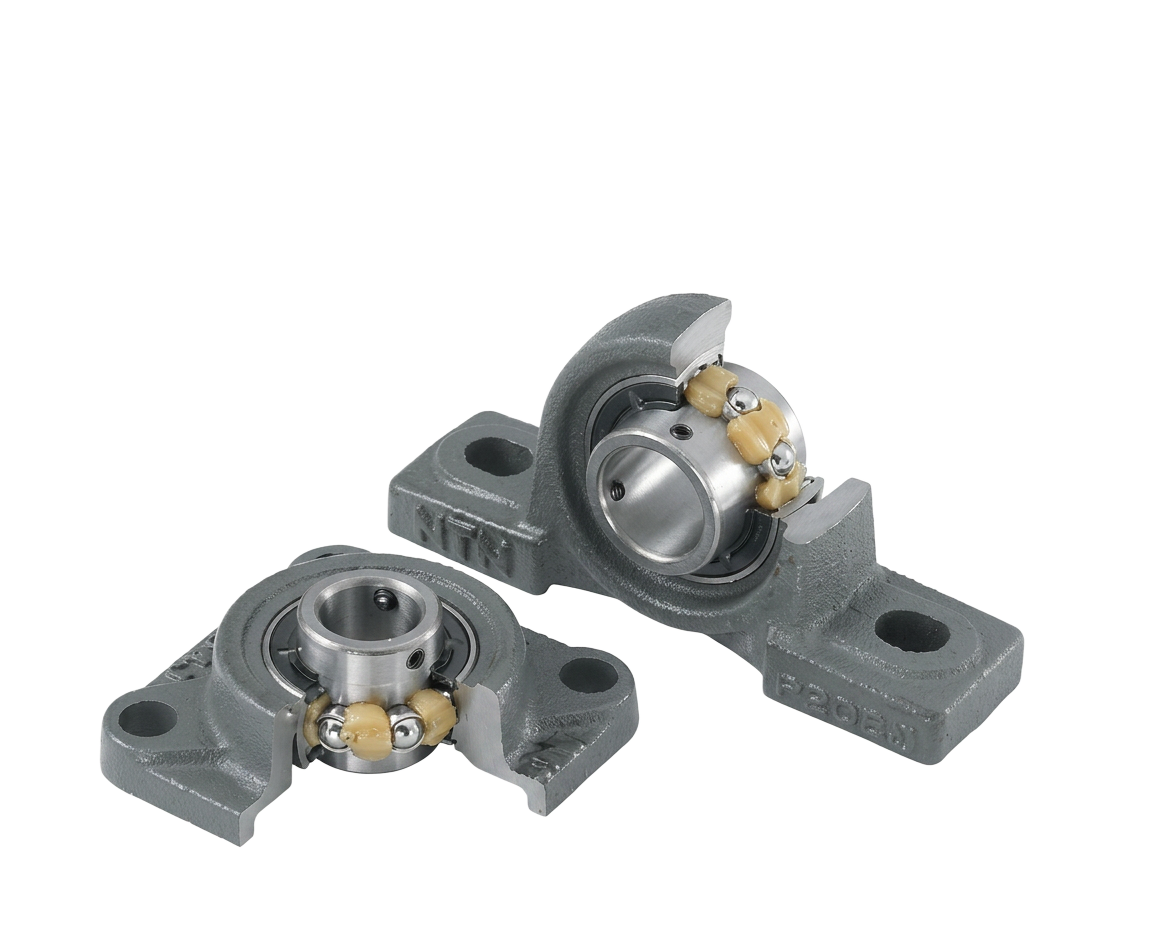
Solid grease is a lubricant composed of lubricating grease and ultra-high polymer polyethylene. It has the same viscosity as ordinary grease at normal temperature, but after a special heat-treatment process it solidifies while retaining a large proportion of the lubricant. Because of this, the grease does not easily leak from the bearing even under strong vibration or centrifugal force, helping to extend bearing life.
1. Reduced lubricant leakage
Base oil is retained in a solid mixture, so it is less likely to leak. Temperature rise or centrifugal force gradually releases the oil into the raceway groove. Eliminating leakage ensures consistent lubrication and prevents contamination of the surrounding environment.
2. Superior lubrication
Solid-grease bearings resist grease leakage and prolong bearing life under high centrifugal force or vibration. The lubricant does not emulsify when exposed to water, extending both grease and bearing life.
3. Low torque characteristics
Running torque of spot-pack bearings with solid grease is lower than with standard lubricants. Conventional greases create shearing resistance as they are channelled out of the raceway; solid grease avoids this, giving lower running torque.
4. Sealing effect
Solid grease resists ingress of water and dust but is not a substitute for a proper seal. For reliable sealing, use contact-type rubber seals (deep-groove ball bearings, bearing units) or other seals appropriate to the bearing type.
| Solid grease (code) | Resin | Lubricant | Operating temperature range (°C) |
|---|---|---|---|
| General-purpose (LP03) | Ultra-high polymer polyethylene1 | Li-mineral oil grease | −20 to +80 (constant use: +60 and less) |
| Food-grade (LP09) | Ultra-high polymer polyethylene1 | Food-grade lubricating grease2 | −10 to +100 (constant use: +80 and less) |
1 Conforms to FDA standard. 2 Conforms to H-1 standard of NSF.